
In a landmark ruling that has sent shockwaves through South Korean politics, former President Yoon Suk Yeol was found guilty of abuse of power, obstructing justice, and falsifying official documents in connection with his controversial and short-lived declaration of martial law in December 2024. The verdict, delivered on January 16, 2026, by the Seoul Central District Court, marks the first conviction in a series of ongoing criminal trials stemming from the dramatic events that led to Yoon’s impeachment and removal from office.
The court sentenced Yoon to five years in prison for these charges, highlighting what judges described as serious violations of constitutional procedures and the misuse of presidential authority. This decision comes amid Yoon’s detention and follows prosecutors’ aggressive pursuit of accountability for what many have called an attempted self-coup.
Background: The Martial Law Crisis of 2024
The saga traces back to the night of December 3, 2024, when Yoon, then the sitting president, abruptly announced a nationwide martial law decree in a televised address. Claiming the measure was necessary to counter “anti-state forces” and protect national security amid political gridlock and investigations into his administration, Yoon ordered troops to surround the National Assembly and restricted political activities.
The declaration stunned the nation and the international community. South Korea had not seen martial law since the 1980s under military dictatorships, and the move was widely viewed as an overreach to stifle opposition and ongoing probes into corruption allegations surrounding Yoon’s wife and key aides.
Within hours, lawmakers defied military blockades, convened an emergency session, and voted unanimously to overturn the decree. The National Assembly’s swift action forced Yoon to lift martial law early on December 4, 2024, after it lasted less than six hours. The episode triggered massive street protests, deepened political polarization, and set off a chain of legal and constitutional proceedings.
In the aftermath, the Constitutional Court upheld the Assembly’s impeachment motion in early 2025, formally removing Yoon from office—the second such ousting of a South Korean president in recent history, following Park Geun-hye in 2017. Yoon was later arrested in late 2025 after resisting summons and barricading himself in his residence, facing multiple indictments.
The Specific Charges in This Verdict
Friday’s ruling focused on a subset of charges related to the martial law bid and its immediate fallout:
- Abuse of power: Yoon failed to convene a full cabinet meeting or secure proper endorsements before issuing the decree, violating constitutional requirements for such an extreme measure. The court found he deliberately bypassed procedural safeguards to impose his will unilaterally.
- Obstructing justice: In January 2025, as investigators sought to arrest him, Yoon allegedly ordered presidential bodyguards to block access, preventing the execution of an arrest warrant. This was deemed an illegal interference with law enforcement duties.
- Falsifying official documents: Prosecutors proved Yoon’s team drafted and then destroyed a backdated or fabricated record falsely claiming that the prime minister and defense minister had endorsed the martial law declaration. This act was intended to legitimize the decree retroactively.
The presiding judge emphasized that these actions not only undermined democratic institutions but also eroded public trust in the presidency. While prosecutors in related cases had sought harsher penalties—including the death penalty in a separate insurrection trial—this verdict carried a five-year term, offering insight into how courts may handle the broader array of charges.
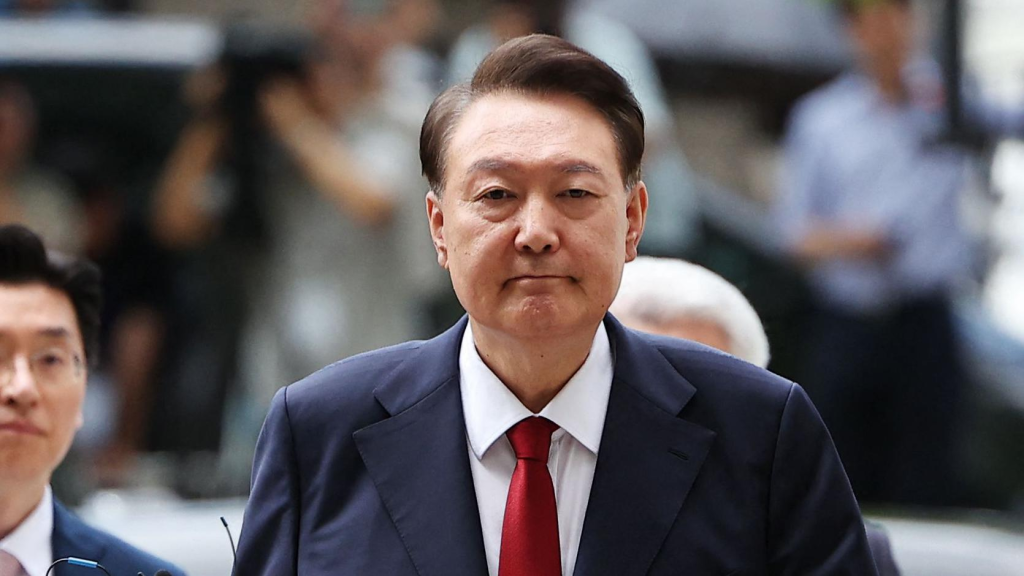
This image shows former President Yoon Suk Yeol arriving at court amid heavy security for one of his trial hearings.
Broader Legal Battles: Multiple Trials Ongoing
This conviction is just the opening chapter in Yoon’s legal ordeal. He faces at least eight separate trials, including the most serious charge of leading an insurrection (or rebellion), for which prosecutors demanded the death penalty in arguments heard earlier in January 2026. That trial concluded recently, with a verdict expected in February.
Other cases involve election law violations, corruption tied to his inner circle, and additional abuse of power allegations. The outcomes could cumulatively result in decades behind bars, though South Korean courts have historically shown leniency in high-profile political cases, and appeals are almost certain.
Yoon has maintained his innocence throughout, portraying the martial law decree as a legitimate, if desperate, response to perceived threats from opposition forces and North Korean provocations. His supporters argue the charges are politically motivated “revenge” by the current liberal administration under President Lee Jae-myung’s party. Critics, however, see the events as a dangerous flirtation with authoritarianism in one of Asia’s most vibrant democracies.
Political and Social Fallout
The verdict has intensified divisions in South Korea. Conservative supporters rallied outside the court, decrying the ruling as judicial overreach, while progressive groups celebrated it as a victory for constitutional order. Public opinion remains split, with polls showing lingering resentment over the 2024 chaos but also fatigue from prolonged political drama.
Economically, the scandal has contributed to uncertainty, though South Korea’s tech-driven markets have largely weathered the storm. Internationally, allies like the United States and Japan watched closely, concerned about stability on the Korean Peninsula amid ongoing tensions with North Korea.
Yoon’s downfall underscores the resilience of South Korea’s democratic institutions—rapid legislative pushback, judicial independence, and civil society mobilization thwarted what could have escalated into a prolonged crisis. Yet it also highlights vulnerabilities in executive power and the risks of polarized politics.
Protesters gather outside the National Assembly during the 2024 martial law crisis, demanding the decree’s reversal.
Looking Ahead
Yoon, now 65 and in custody, is expected to appeal this conviction vigorously. His legal team has already signaled intent to challenge the findings on procedural grounds and the interpretation of presidential authority.
Meanwhile, the separate insurrection trial looms as the definitive test. A death sentence—though rare and often commuted in practice—would be unprecedented for a former president in modern South Korea. Even a lengthy prison term could cement Yoon’s legacy as a cautionary tale of executive overreach.
For South Koreans, the ruling reaffirms the rule of law but also prompts reflection on how to prevent future constitutional crises. As one political analyst noted, “The martial law bid failed quickly, but its legal reckoning will shape Korean democracy for years.”
This historic verdict closes one phase of accountability while opening others, ensuring the 2024 events remain a pivotal chapter in South Korea’s post-democratization story.


Leave a Reply