
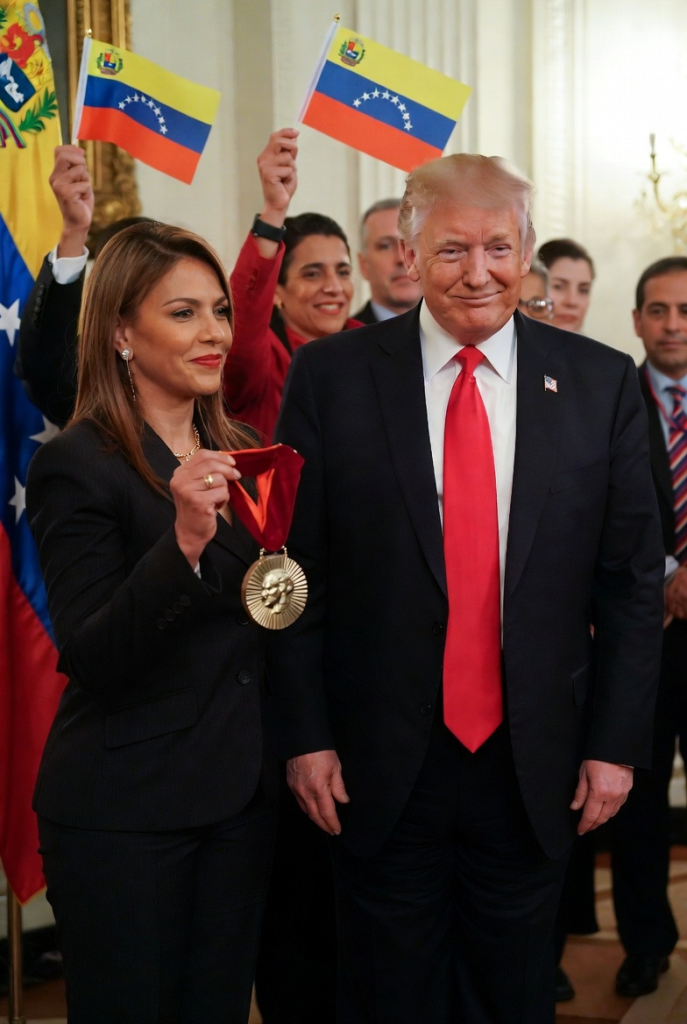
Venezuelan opposition leader María Corina Machado, the recipient of the 2025 Nobel Peace Prize, presented her Nobel medal to U.S. President Donald Trump during a private White House meeting on Thursday, January 15, 2026. She described the gesture as a symbol of gratitude for what she called Trump’s “unique commitment” to Venezuela’s freedom, following the dramatic U.S. capture of former President Nicolás Maduro earlier this month.
The meeting, held in the Oval Office, marked the first in-person encounter between the two figures. Machado, a prominent critic of the Maduro regime and leader of Venezuela’s opposition coalition, used the occasion to highlight her ongoing push for international recognition of her movement’s claimed victory in the disputed 2024 presidential elections. Trump, who has long expressed a desire for the Nobel Peace Prize himself, accepted the medal and later praised the act on social media as “a wonderful gesture of mutual respect.”
In statements to reporters after the session, Machado declared, “I presented the president of the United States the medal of the Nobel Peace Prize as a recognition for his unique commitment with our freedom.” She framed the act as a reciprocal symbol of solidarity, drawing a historical parallel to the Marquis de Lafayette gifting a George Washington medal to Simón Bolívar during Venezuela’s independence struggle. “Two hundred years later, the people of Bolívar are giving back to the heir of Washington a medal—in this case, the Nobel Peace Prize—as acknowledgment of the shared fight against tyranny,” she said.
Trump responded positively in a post on his social media platform, writing: “María presented me with her Nobel Peace Prize for the work I have done. Such a wonderful gesture of mutual respect. Thank you María! She is a wonderful woman who has been through so much.” He described meeting her as “a great honor,” though he stopped short of endorsing her as Venezuela’s legitimate leader amid the country’s ongoing political transition.
The Nobel Committee has repeatedly clarified that the prize itself is non-transferable. In a statement issued last week, the Norwegian Nobel Committee emphasized: “Once a Nobel Prize is announced, it cannot be revoked, shared, or transferred to others. The decision is final and stands for all time.” The Nobel Peace Center reinforced this on social media prior to the meeting, noting that “a medal can change owners, but the title of a Nobel Peace Prize laureate cannot.” Despite these reminders, Machado proceeded with the presentation, handing over the physical gold medal during the closed-door discussion.
Machado was awarded the 2025 Nobel Peace Prize in October 2025 “for her tireless work promoting democratic rights for the people of Venezuela and for her struggle to achieve a just and peaceful transition from dictatorship to democracy.” The honor recognized her persistent efforts against authoritarian rule, including facing disqualification from office, threats, and exile-like restrictions under Maduro’s government.
The White House encounter unfolded against a backdrop of rapid U.S. intervention in Venezuela. On January 3, 2026, U.S. special forces executed “Operation Absolute Resolve,” capturing Maduro and his wife, Cilia Flores, in Caracas during a raid. Maduro was transported to the United States, where he now faces longstanding federal charges including narco-terrorism, cocaine importation conspiracy, and weapons offenses. He is detained at the Metropolitan Detention Center in Brooklyn, New York, and has proclaimed his innocence, labeling the action a “kidnapping.”
Since Maduro’s removal, the Trump administration has engaged with Delcy Rodríguez, Maduro’s former vice president and now acting head of state in the transitional government. Trump spoke with Rodríguez by phone on Wednesday, describing her as “a terrific person” and the call as marked by “mutual respect.” Rodríguez, in her annual address to the nation on Thursday, expressed willingness to visit Washington and pursue diplomacy, stating she would attend meetings “standing tall, walking, and not crawling.”
Trump has declined to recognize Machado or her coalition as the rightful successors, citing concerns over her domestic support base despite widespread international criticism of the 2024 election results. White House Press Secretary Karoline Leavitt described Machado as “a remarkable and brave voice for many of the people of Venezuela” and said Trump anticipated a “frank and positive discussion” on Venezuela’s realities.
Machado used her Washington visit to lobby for greater U.S. backing of her opposition bloc. After the White House, she met with U.S. senators on Capitol Hill, where supporters outside chanted “María, presidente” and waved Venezuelan flags, occasionally drowning out her remarks. She argued that aligning with Rodríguez’s interim administration was misguided and that her coalition should guide the transition.
The U.S. has moved swiftly on economic fronts since Maduro’s capture. On Wednesday, an American official announced the completion of the first U.S.-facilitated sale of Venezuelan oil, valued at $500 million, signaling efforts to reshape the sanctioned energy sector. U.S. forces have also boarded and seized multiple tankers suspected of carrying sanctioned Venezuelan crude, with a sixth interception reported on Thursday.
A Venezuelan government envoy, described as a close ally of Rodríguez, is slated to arrive in Washington for talks on reopening the country’s embassy and normalizing relations. These developments highlight the Trump administration’s pragmatic approach, prioritizing stability, oil access, and counter-narcotics goals over fully endorsing one faction in Venezuela’s fractured political landscape.
Machado’s symbolic gift of the medal appears aimed at swaying Trump personally, leveraging his known affinity for the Nobel accolade. While the gesture garnered headlines and expressions of gratitude from Trump, it has not yet translated into a shift in policy. Analysts note the move as a high-profile diplomatic play amid uncertainty over Venezuela’s future leadership.
Outside the White House gates, Machado addressed cheering supporters in Spanish, assuring them, “We can count on President Trump.” The episode underscores the complex interplay of symbolism, power, and geopolitics in U.S.-Venezuela relations at this pivotal moment.
These images depict María Corina Machado presenting her Nobel Peace Prize medal to President Donald Trump during their White House meeting on January 15, 2026, along with related scenes from the event and her interactions with supporters.


Leave a Reply