
The controversy erupted when US Commerce Secretary Howard Lutnick made startling remarks in an interview on the All-In Podcast with Chamath Palihapitiya, claiming that a much-anticipated bilateral trade deal between the United States and India failed to materialize primarily because Prime Minister Narendra Modi did not personally call President Donald Trump to finalize it.
According to Lutnick, the deal was “all set up” by negotiators, with the US positioning India as a priority after sealing an agreement with the UK. He described Trump as the “closer” in such deals, emphasizing that a direct call from Modi was expected at a critical juncture—allegedly within a window of “three Fridays.” Lutnick suggested that Indian officials were “uncomfortable” making the call, leading to the opportunity slipping away. He further noted that the US later withdrew from the agreed terms, and now any future deal would come at less favorable conditions for India, amid heightened tariffs.
Lutnick’s comments implied that Trump’s tough stance on tariffs— including a reported 50% effective rate on some Indian goods, incorporating reciprocal duties and penalties linked to India’s purchases of Russian oil—was partly rooted in personal frustration rather than pure economic policy. This revelation painted the impasse as more about ego and personal diplomacy than substantive trade barriers, such as market access in agriculture or other sectors that had long been speculated as sticking points.
The remarks sparked immediate backlash in India. The Ministry of External Affairs (MEA) swiftly rejected Lutnick’s characterization as “not accurate.” Spokesperson Randhir Jaiswal highlighted that PM Modi and President Trump had spoken on the phone eight times in 2025, discussing various aspects of the bilateral partnership. He reaffirmed India’s commitment to a balanced and mutually beneficial trade agreement, noting that multiple rounds of negotiations had brought the two sides close to a deal on several occasions since formal talks began following a February 2025 meeting between the leaders.
Adding fuel to the fire, author and political commentator Navroop Singh delivered a sharp rebuke to Lutnick. In a widely circulated statement, Singh accused the US official of misunderstanding the dynamics and asserted: “You didn’t hurt Modi, you hurt Indians.” Singh argued that the US actions—imposing a 25% penalty tariff linked to India’s Russian oil purchases, tightening H-1B visa policies affecting Indian professionals, appearing to endorse Pakistan’s military leadership (such as Field Marshal Asim Munir), and even taking credit for India-Pakistan ceasefires—were not strikes against the Indian Prime Minister personally but against the interests and aspirations of ordinary Indian citizens.
Singh’s critique framed the episode as emblematic of broader US arrogance in international relations under the current administration. He pointed out that while Lutnick portrayed the stalled deal as a missed personal courtesy, the real damage lay in economic measures that inflate costs for Indian consumers, disrupt tech and services sectors reliant on US visas, and complicate India’s strategic energy choices amid global geopolitical pressures.
The broader context of India-US trade relations has been tense. Negotiations for a bilateral trade agreement (often referred to as a mini-deal or framework pact) have dragged on since early 2025, with the US pushing for greater market access and India seeking tariff relief and protections for its farmers and industries. Trump’s repeated warnings about tariffs—tied to India’s continued imports of discounted Russian oil post-Ukraine conflict—have added complexity. India has defended its energy sourcing as a necessity for its population’s needs, though reports indicate some reduction in Russian purchases by refiners due to tariff fears.
Lutnick’s podcast appearance also referenced other countries like Indonesia, the Philippines, and Vietnam advancing in trade talks, suggesting India lost its “first stair” advantage in Trump’s deal-making staircase approach. He claimed India now faces higher rates and that any revival would depend on Trump deciding “how he will deal with Modi.”
Public and expert reactions in India have largely sided with the government’s rebuttal, viewing Lutnick’s comments as undiplomatic and revealing of a transactional, personality-driven approach to foreign policy. Analysts note that while leader-to-leader calls are common in diplomacy, expecting one as a precondition for a deal—especially when multiple interactions had already occurred—strikes many as unreasonable.
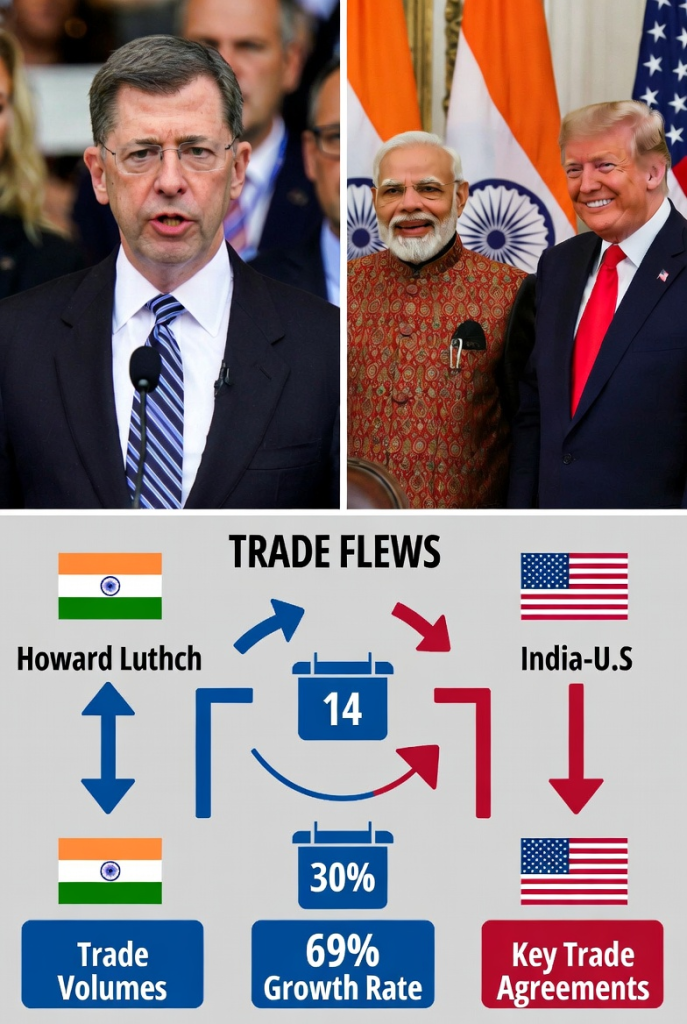
This image shows US Commerce Secretary Howard Lutnick speaking at a public event, highlighting his role in the Trump administration’s trade agenda.
Prime Minister Narendra Modi and President Donald Trump during a previous bilateral meeting, symbolizing the strong personal rapport claimed despite the recent spat.
A visual representation of India-US trade flows, with containers and flags, underscoring the economic stakes in the stalled negotiations.
The episode underscores the challenges in balancing national pride, economic pragmatism, and personal diplomacy in high-stakes international relations. As both sides express continued interest in a deal, the coming months will test whether negotiators can move beyond the rhetoric and bruised egos to deliver tangible benefits for businesses and citizens on both sides. For now, Navroop Singh’s pointed words resonate widely in India: the fallout from such public spats and tariff threats ultimately burdens everyday people, not just political figures.


Leave a Reply